

UTILITY SURVEYS
UTILITY CLEARANCE
& PAS128 SURVEYS
Professional Utility Clearance and PAS 128 Surveys using Ground Penetrating Radar (GPR), Electromagnetic (EM) Locating and industry-recognised survey methodologies to help engineers, contractors and developers plan, excavate and build with confidence.
PROFESSIONAL. ACCURATE. RELIABLE.
What is Utility Clearance Survey?
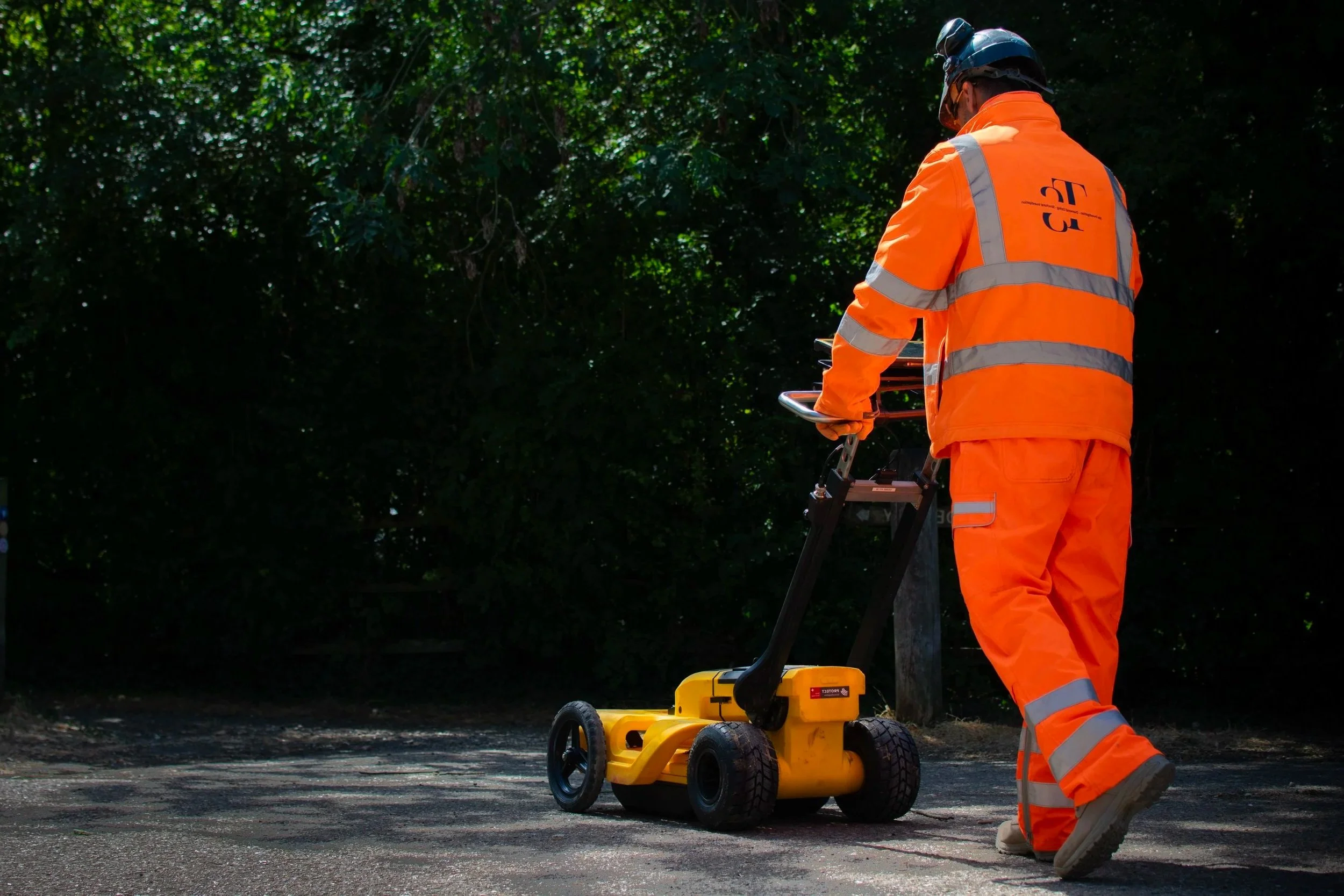
Our Utility Clearance Surveys identify and map buried underground services prior to excavation, drilling, coring and other intrusive works. Using Ground Penetrating Radar (GPR), Electromagnetic (EM) Locating and PAS128 compliant survey methodologies where specified, we provide accurate utility information to reduce risk, improve safety and support informed engineering decisions.
Surveys are delivered by experienced operatives with industry-leading equipment and in accordance with current industry standards.
Reduce Risk
Identify underground utilities and avoid costly service strikes.

Save Time & Money
Prevent delays, rework and unplanned disruption.

Improve Safety
Protect your team, the public and critical infrastructure.


Support Compliance
PAS128 compliant surveys available to required Quality Levels (D.C, B, A).
HOW WE DELIVER RESULTS
Our Survey Methods
→
GPR SURVEYS
Ground Penetrating Radar (GPR) is used to detect both metallic and non-metallic utilities, voids, foundations and subsurface anomalies.
EM LOCATING
Electromagnetic (EM) locating detects buried metallic utilities using active and passive locating techniques, allowing underground services to be accurately traced and mapped.
PAS128 SURVEYS
Surveys are conducted in accordance with PAS128 surveys specification to the required Quality Level (D.C.,B, or A).
UTILITY MAPPING
We provide clear. accurate deliverables including CAD drawings. PDF plans and survey reports to support your project.
→
→
Underground Services We Can Identify
WHAT WE DETECT

Electric Cables
Gas Mains
Water Pipes
Drainage
Telecoms
Voids


Tanks & Chambers
Concrete Reinforcement
WHY IT MATTERS
Avoid Disruption. Protect Your Project.
Underground utility strikes can cause serious injury & project delays. reputation damage and significant financial costs.
A professional utility clearance survey gives you the information you need to plan safely, comply with regulations and keep your project on track.
FAQs
-
A Utility Clearance Survey is carried out to identify buried underground services before excavation, drilling, trial pitting, diamond coring and other intrusive works. A PAS 128 Survey follows the PAS 128 specification, which defines recognised survey methodologies and Quality Levels (QL-D, QL-C, QL-B and QL-A) for utility detection and mapping.
Not every project requires a PAS 128 compliant survey; however, where higher levels of confidence, detailed utility mapping or engineering design information are required, a PAS 128 survey is often specified by the client or design team.
-
Utility Clearance Surveys should be completed before any intrusive ground investigation or construction works commence. They are commonly undertaken prior to trial pitting, borehole drilling, window sampling, dynamic probing (DPSH), diamond coring, piling, excavation, vacuum excavation and structural investigations.
Carrying out a survey before breaking ground helps identify buried utilities, reduce the risk of service strikes, improve site safety and minimise costly delays or damage to existing infrastructure.
-
There is no fixed expiry period for a Utility Clearance or PAS 128 Survey. However, the accuracy of any survey depends on whether changes have occurred since it was completed.
If utility diversions, new installations, major construction works or excavation have taken place after the original survey, a new survey is generally recommended before commencing intrusive works. Many clients also request updated utility surveys where several months have elapsed between the original survey and construction.
-
Item deUsing a combination of Ground Penetrating Radar (GPR) and Electromagnetic (EM) locating, Utility Clearance Surveys can identify a wide range of underground services including:
Electrical cables
Gas mains
Water pipes
Drainage systems
Telecommunications and fibre optic ducts
Street lighting cables
Utility ducts
Concrete reinforcement
Underground tanks and chambers
Voids and subsurface anomalies where detectable
The appropriate survey methodology depends on site conditions, utility type and the required survey specification.
-
The deliverables provided depend on your project requirements, survey specification and client requirements.
For projects requiring rapid utility clearance, we can attend site to carry out the survey, provide on-site utility marking and verbally brief the site team, allowing works to proceed quickly where formal deliverables are not required.
Where required, we can also provide a full range of survey deliverables including PAS 128 compliant reports, CAD utility drawings, PDF utility plans, underground utility mapping and supporting survey data. Whether your project requires simple utility clearance or a fully documented PAS 128 survey, we tailor our deliverables to suit your programme and engineering requirements.
-
Yes. Unlike many utility survey providers, TS Site Investigation can deliver the entire investigation process in-house.
Where verification is required, we can safely expose identified services using our own experienced operatives, trial pitting teams, excavation equipment and specialist plant. This enables us to verify the position, depth and type of buried utilities without relying on multiple subcontractors, helping reduce programme delays, mobilisation costs and unnecessary coordination.
Where a PAS 128 Quality Level A (QL-A) verification is specified, our intrusive investigation capabilities allow detected utilities to be physically exposed and verified in accordance with the project requirements. As we also undertake trial pitting, diamond coring, structural investigations and ground investigations, clients benefit from a single contractor managing the utility survey, verification and subsequent intrusive works—providing a more efficient programme, improved communication and a smoother project delivery.