
What Is Diamond Drilling?
Diamond drilling is a precise drilling technique that uses diamond-tipped drill bits to cut clean, circular holes through hard materials such as concrete, masonry, asphalt, or stone.
The diamond segments allow the drill to operate efficiently with minimal vibration, producing smooth, accurate cores while preserving the integrity of the surrounding structure.
This method is widely used across construction, civil engineering, and structural investigations to extract samples for testing, create openings for services, or inspect internal reinforcement and material condition.
Because of its low noise, dust, and vibration levels, diamond coring is ideal for live sites, confined areas, or sensitive environments.
How We Carry Out Diamond Coring
At TS Site Investigation, we conduct diamond coring with precision and full adherence to our site-specific Risk Assessments and Method Statements (RAMS).
All works are planned in compliance with CDM 2015 and relevant British Standards to ensure safety and consistency.
Before drilling, our teams complete:
Service scans (CAT & Genny or GPR) to locate hidden utilities.
Access and safety assessments to determine the correct rig setup, power supply, and water-management system.
Method statements outlining drilling technique, sample handling, and reinstatement procedure.
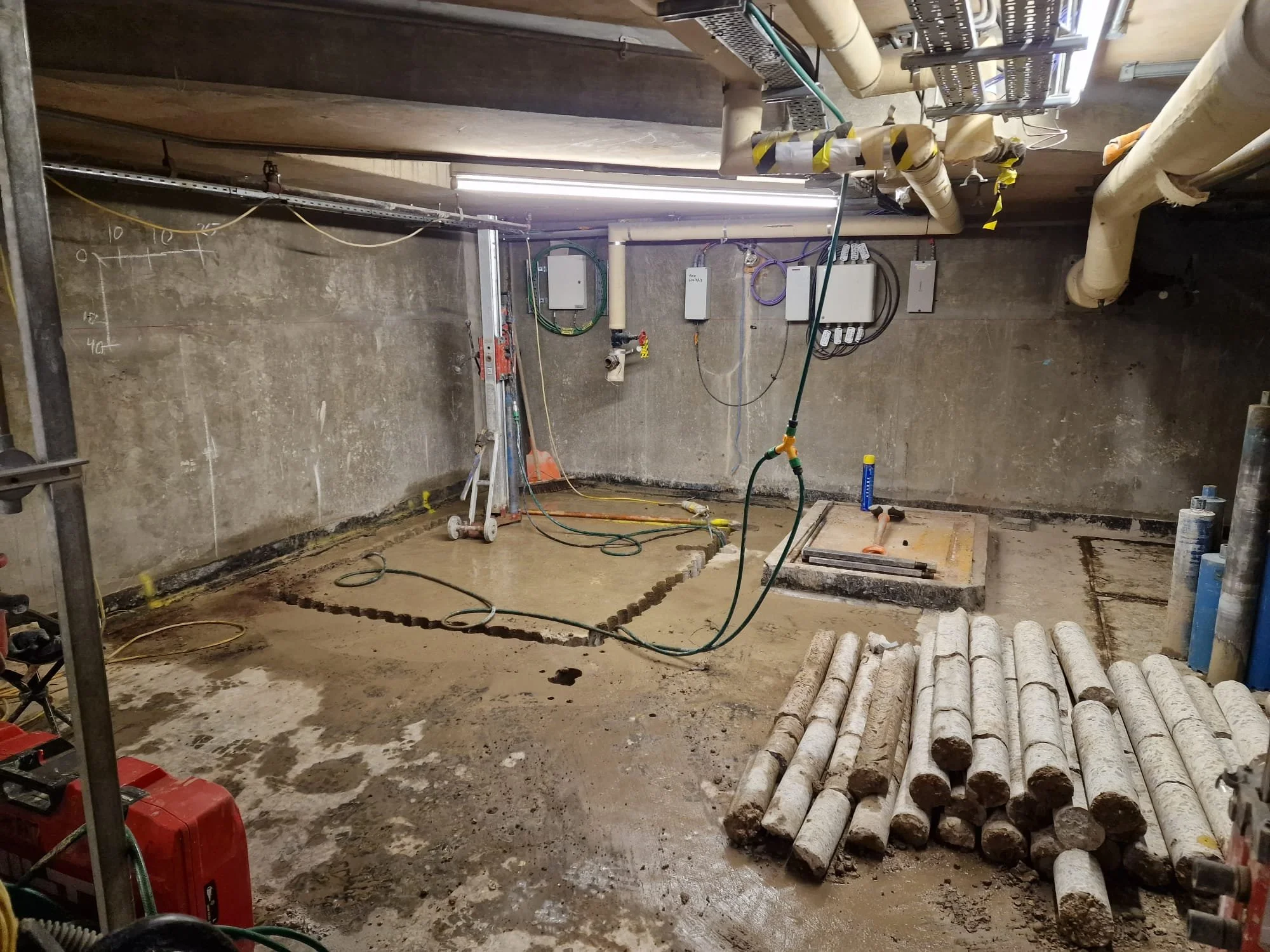
During coring, we use both hand-held and rig-mounted diamond drills depending on the material and diameter required.
Our capability includes:
Standard core drilling for concrete, masonry, or asphalt (typically 50 mm – 300 mm).
Stitch coring, where overlapping cores create larger openings for ducts, vents, or inspection access.
Inclined or horizontal coring, allowing investigation of walls, soffits, or foundations at varying angles.
Core extraction for testing, supplying intact samples for laboratory analysis of compressive strength, carbonation, or chloride content.
Water-cooled systems and vacuum attachments minimise dust and debris, ensuring a clean, controlled operation even in sensitive locations.
Upon completion, all holes are sealed or reinstated to client requirements, with detailed logs and photographs provided in our report.
Applications of Diamond Coring
Diamond coring is a versatile solution for:
Obtaining concrete or masonry cores for laboratory testing.
Creating precise service penetrations in slabs, walls, or structural members.
Investigating reinforcement layouts and material condition within existing structures.
Accessing embedded elements for rebar verification or structural sampling.
Supporting structural, geotechnical, or environmental assessments where high accuracy is required.
Who Requires Diamond Coring and Why
Our diamond coring services support a wide range of clients, including:
Structural engineers verifying existing concrete strength or composition.
Contractors and developers needing clean openings for mechanical or electrical services.
Architects and surveyors assessing existing buildings prior to refurbishment.
Local authorities, insurers, and consultants undertaking structural integrity or compliance checks.
Diamond coring provides non-destructive precision and dependable data, helping clients avoid unnecessary damage while obtaining the critical information needed for safe, informed decision-making.
Why Choose TS Site Investigation
Full RAMS and CDM 2015 compliance on every project.
Experienced technicians trained in both wet and dry coring methods.
Modern, low-vibration equipment suitable for confined or occupied sites.
Accurate reporting with photographic evidence, sample tracking, and clear recommendations.
Our commitment to safety, quality, and efficiency ensures every coring operation is delivered to the highest professional standard.
FAQs
-
Coring costs depend on several variables, including:
Core diameter and depth
Material type (reinforced concrete, masonry, asphalt)
Access limitations (confined spaces, basements, high-level areas)
Number of holes required
Stitch-coring vs. standard coring
Water-management needs and reinstatement
We provide clear, transparent pricing after assessing your drawings or project requirements.
-
Yes. Stitch coring is often required when creating openings for ducts, risers, doorways, or inspection access. We drill a series of overlapping holes that can be broken out cleanly to create larger penetrations. This method is especially useful in reinforced concrete where saw-cutting isn’t feasible.
-
The required core size depends on the purpose of the hole—whether it’s for service penetrations, structural testing, vent openings, or reinforcement inspection. Our team can assess your drawings, site requirements, or existing structures to recommend the correct diameter and drilling method. We supply a wide range of core sizes (typically 50–400 mm), and can advise clients before drilling to avoid unnecessary cost or re-drilling.