
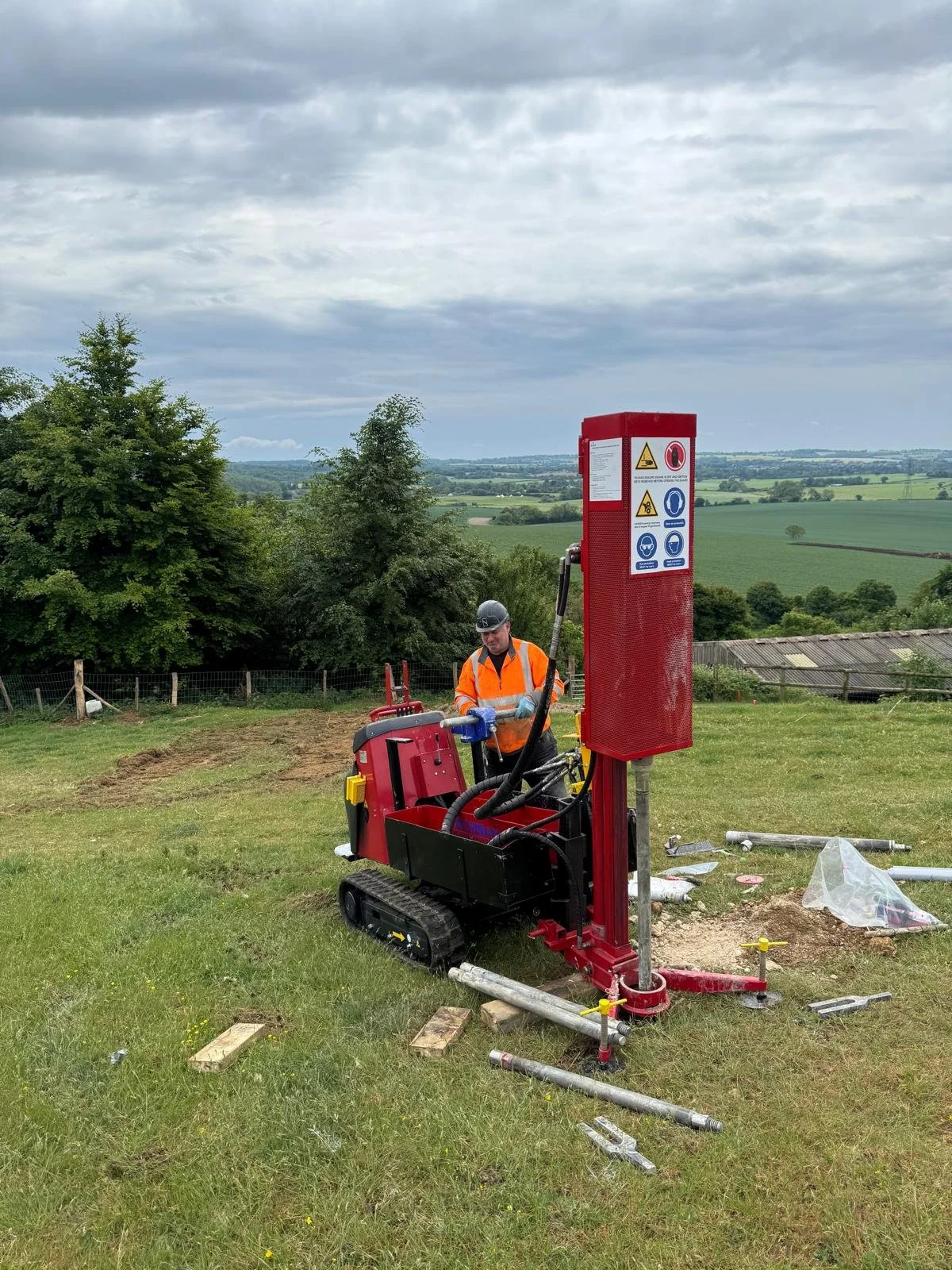
What Is Dynamic Sampling?
Dynamic Sampling is a rapid, reliable ground investigation technique used to assess and record shallow soil conditions.
The method involves driving a steel sampling tube or “window sampler” into the ground using a percussive hammer system, allowing soil samples to be recovered at regular depths for visual logging and laboratory testing.
This process provides a continuous soil profile, helping engineers and designers understand ground composition, strength, and suitability for foundations or contamination assessments.
It’s especially valuable where traditional boreholes are not practical or where access is restricted — such as back gardens, pavements, or inside buildings.
How We Carry Out Dynamic Sampling
At TS Site Investigation, we operate a fleet of modern window sample rigs designed for fast, efficient, and low-impact sampling.
Every project is completed under a site-specific Risk Assessment and Method Statement (RAMS) in compliance with CDM 2015 and relevant British Standards (BS 5930, BS EN ISO 22475).
Our process typically includes:
Mobilisation and setup of a window sampling rig at predetermined investigation points.
Dynamic driving of the sampler into the ground using a percussive hammer to collect undisturbed samples at regular depth intervals.
Logging of the soil profile by qualified technicians using BS 5930 standards.
Collection of samples for laboratory testing, including moisture content, contamination, strength, or classification.
In-situ testing, such as Standard Penetration Tests (SPT) or Dynamic Cone Penetrometer (DCP) tests, to assess ground resistance.
Installation of gas or groundwater monitoring wells where required.
Backfilling and reinstatement of all boreholes upon completion.
Because our rigs are compact and versatile, we can access both open sites and confined locations with minimal disturbance.
Applications of Dynamic Sampling
Dynamic sampling is widely used for:
Foundation and geotechnical assessments for residential and commercial developments.
Contamination and environmental studies, providing soil samples for lab testing.
Preliminary ground investigation before construction or drainage design.
Monitoring well installation for gas, groundwater, or VOC assessment.
Restricted-access sites, including basements, gardens, and urban environments.
Why Is Dynamic Sampling Important?
Dynamic sampling provides a cost-effective and efficient alternative to traditional drilling techniques for shallow investigations.
It allows for rapid assessment of soil consistency, strength, and layering, helping to reduce design uncertainty and project delays.
The method also offers excellent sample recovery and minimal ground disturbance, making it ideal for environmentally sensitive or developed sites.
Why Choose TS Site Investigation?
Fully RAMS and CDM 2015 compliant on every project.
Modern electric and hydraulic-powered rigs suited for all site conditions.
Experienced field teams trained in sampling, SPT testing, and monitoring installation.
Detailed reporting, including soil logs, photographs, and laboratory data.
Our team combines precision, safety, and efficiency to deliver reliable data for both geotechnical and environmental projects.
FAQs
-
Dynamic sampling provides highly reliable data for shallow investigations (typically 0–6m). While it doesn’t replace deep rotary drilling, it is extremely accurate for:
near-surface soil profiling
contamination screening
foundation / bearing assessments
environmental monitoring
Because samples are taken at close intervals, it often delivers better stratigraphic detail than spaced borehole logs making it ideal for preliminary design and risk assessments.
-
Yes. Window sample rigs are specifically designed for tight or sensitive locations:
small residential gardens
narrow side access
inside buildings
courtyards
steep or uneven terrain
restricted commercial sites
-
Yes. Window sampler holes can be converted into:
ground-gas monitoring wells
water monitoring wells
VOC/vapour installations
This is extremely useful for site investigation phases and environmental risk assessments.
-
Dynamic sampling can recover:
Disturbed samples for classification, moisture, contamination, and general geotechnical testing
Undisturbed samples (using U100 / thin-walled samplers) for strength testing, consolidation tests, and detailed lab analysis
SPT or DCP results where penetration resistance is needed