
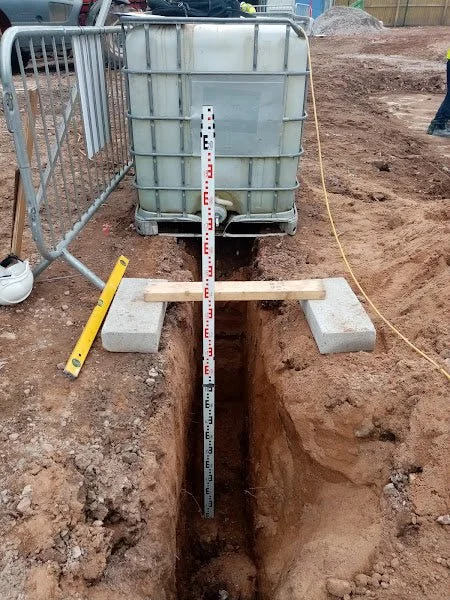
What Is BRE 365 Soakaway Test?
A BRE 365 soakaway test (sometimes called an infiltration or percolation test) is a site-based investigation used to determine how quickly surface water drains into the ground.
The results are essential for designing soakaways, infiltration systems, and sustainable drainage (SuDS) solutions in line with Building Regulations Part H and the Building Research Establishment (BRE) Digest 365 guidelines.
In simple terms, the test measures how efficiently rainwater can soak away from the surface through the soil, helping engineers design drainage systems that are both safe and environmentally compliant.
How We Carry Out Soakaway Tests
At TS Site Investigation, our soakaway tests are carried out in strict accordance with BRE Digest 365 and supported by full Risk Assessment and Method Statements (RAMS) under CDM 2015.
We follow a structured, accurate procedure to ensure reliable results that meet planning and regulatory standards.
Our typical process includes:
Excavation of a test pit at the proposed soakaway location using a mini-excavator or hand tools.
Recording ground conditions, soil type, and water table level.
Filling the pit with clean water, either manually or using a bowser, to simulate rainfall infiltration.
Monitoring the water level drop over time using measuring tapes, digital sensors, or data loggers.
Repeating the test to obtain consistent and representative results for calculation.
Calculating the infiltration rate (f-value) in accordance with BRE 365, providing clear data for design engineers.
Upon completion, the pit is backfilled and reinstated to client standards, with all data and observations documented within a detailed report.
Applications of BRE 365 Soakaway Testing
Soakaway tests are required for a wide range of developments, including:
Residential and commercial construction projects requiring sustainable drainage systems (SuDS).
Highway and car park developments, where surface water management is critical.
Extensions or redevelopments that increase impermeable surface areas.
Planning and environmental submissions, where local authorities require infiltration data.
Why Is Soakaway Testing Important?
Poor drainage design can lead to flooding, surface ponding, or long-term structural damage.
A BRE 365 soakaway test ensures:
Your drainage design meets planning and regulatory approval.
Surface water is managed sustainably and efficiently.
Engineers have the correct infiltration rate (f-value) for soakaway or infiltration trench design.
You avoid costly redesigns or non-compliance issues during construction.
By performing these tests early in the project, clients gain the data needed to design effective and compliant drainage solutions.
Why Choose TS Site Investigation?
Fully RAMS and CDM 2015 compliant on all works.
Experienced technicians trained in BRE 365 methodology and safe excavation.
Ability to perform tests alongside trial pitting or dynamic sampling for combined ground and drainage investigations.
Fast mobilisation and clear, engineer-ready reporting with all calculations and site logs.
We take pride in delivering accurate, transparent results that support efficient drainage design and planning approval.
FAQs
-
typical BRE 365 soakaway test can take anywhere from 4 hours to a full day, depending on ground conditions, weather, water infiltration rate, and the number of test runs required.
Slower-draining soils (like clay) require longer monitoring intervals, while free-draining soils (like sand or gravel) may complete much faster.Engineers often plan for at least half a day on site, plus additional time for calculation and reporting. If multiple test pits are required for large developments, testing may extend over 1–2 days.
-
BRE 365 requires a test pit that represents the intended soakaway.
Typical sizes include:1m x 1m x 1m (small domestic tests)
1.5m x 1m x 2m (larger developments)
Larger pits for commercial drainage systems
We excavate to the proposed invert depth of the soakaway so results accurately represent real-world performance.
-
When performed correctly according to BRE Digest 365, tests provide highly reliable infiltration data.
Accuracy depends on:Controlled water discharge
Proper equipment calibration
Recording water levels at correct intervals
Compliance with BS standards and BRE procedures
Our teams produce high-accuracy results with photographic logs, time-stamped readings, and clear calculations.
-
Sometimes yes.
Multiple tests may be required if:The development covers a large area
Soil conditions vary across the site
Different drainage zones are planned
The LLFA requests multiple infiltration points
A single domestic extension often requires only one test, but commercial or multi-unit developments may need several.