
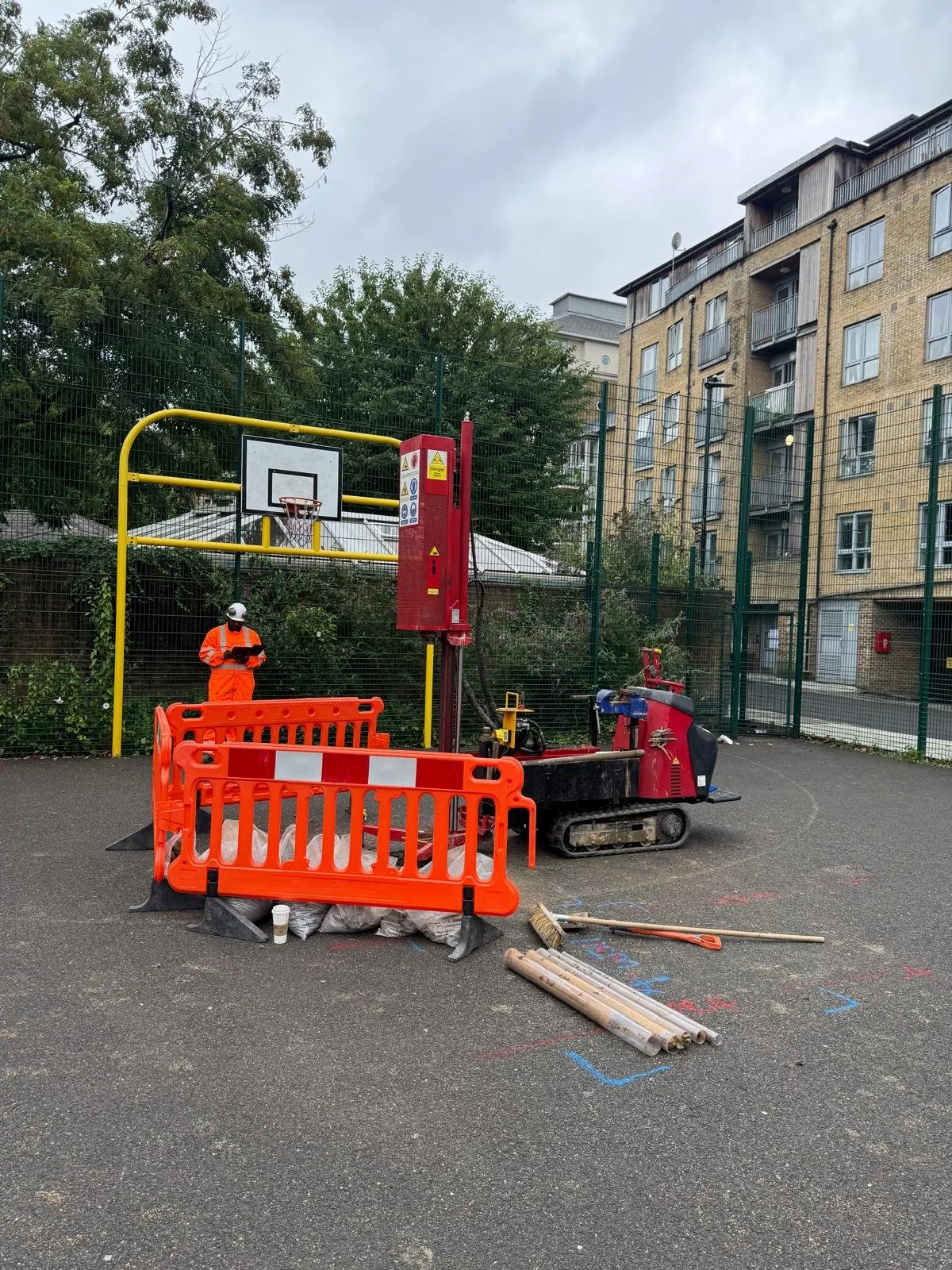
What Is Dynamic Probe Testing (DPSH)?
Dynamic Probe Testing (DPSH) is an in-situ ground investigation technique used to measure soil strength, density, and stratification.
The test involves driving a steel cone into the ground using a controlled series of hammer blows and recording the number of blows required to achieve set penetration intervals.
This data provides a continuous profile of the soil’s resistance, helping engineers determine bearing capacity, compaction, and consistency at varying depths.
It is particularly valuable where rapid, low-cost, or multiple location testing is required — such as housing developments, infrastructure sites, and areas unsuitable for heavy drilling equipment.
How We Carry Out DPSH Testing
At TS Site Investigation, our Dynamic Probe Testing is conducted in accordance with BS EN ISO 22476-2 and under fully developed Risk Assessments and Method Statements (RAMS) compliant with CDM 2015.
Our experienced technicians ensure all work is performed safely, accurately, and with minimal site disruption.
The process typically includes:
Setting up the probe rig at each investigation location.
Driving a steel cone of standard geometry into the ground using a calibrated drop hammer.
Recording blow counts at fixed depth intervals to measure penetration resistance.
Logging the soil profile and correlating results with borehole or trial pit data where available.
We operate both diesel and electric-powered rigs, allowing access to open, restricted, and environmentally sensitive sites. Electric rigs are ideal for indoor or noise-controlled environments, while diesel units provide the power and reach for deeper or harder ground.
Applications of Dynamic Probe Testing
Dynamic probing is a versatile and widely used method for:
Assessing soil strength and density for foundation design.
Mapping ground consistency across large or variable sites.
Comparing compaction quality after earthworks or ground improvement.
Correlating with in-situ tests such as SPT or CBR for geotechnical design.
Preliminary site assessment before drilling, sampling, or piling.
Why Is Dynamic Probe Testing Important?
The DPSH test provides fast, cost-effective, and repeatable results that help engineers understand near-surface ground behaviour without the need for complex drilling or sampling.
It reduces design uncertainty by revealing variations in soil strength, highlighting areas of soft ground or poor compaction early in the project.
By integrating DPSH results with data from trial pits, window sampling, or laboratory testing, engineers gain a reliable overview of the ground profile to inform safe and efficient foundation design.
Why Choose TS Site Investigation?
Fully RAMS and CDM 2015 compliant on all testing operations.
Fleet of diesel and electric-powered rigs for all site conditions.
Experienced technicians trained in in-situ geotechnical testing and data interpretation.
Detailed digital reports with blow counts, depth charts, and engineering summaries.
Our focus is on accuracy, safety, and adaptability — providing clear data you can trust to make informed design decisions.
FAQs
-
DPSH is highly reliable for identifying soil density variations, weak zones, compaction levels, and bearing capacity trends. While it doesn’t replace full laboratory testing, it gives consistent, repeatable data that correlates well with SPT, CBR, and laboratory results when interpreted by qualified engineers.
-
Yes. We operate electric-powered rigs designed specifically for indoor, basement, or noise-sensitive environments. They produce low vibration, no fumes, and can pass through tight access points, making DPSH suitable for refurbishment or confined-space projects.
-
Depending on ground conditions, DPSH testing typically reaches 6–10 metres, sometimes deeper if soils are soft enough. Hard granular layers or obstructions may reduce depth, but engineers can often switch to a heavy-duty probe if needed.