
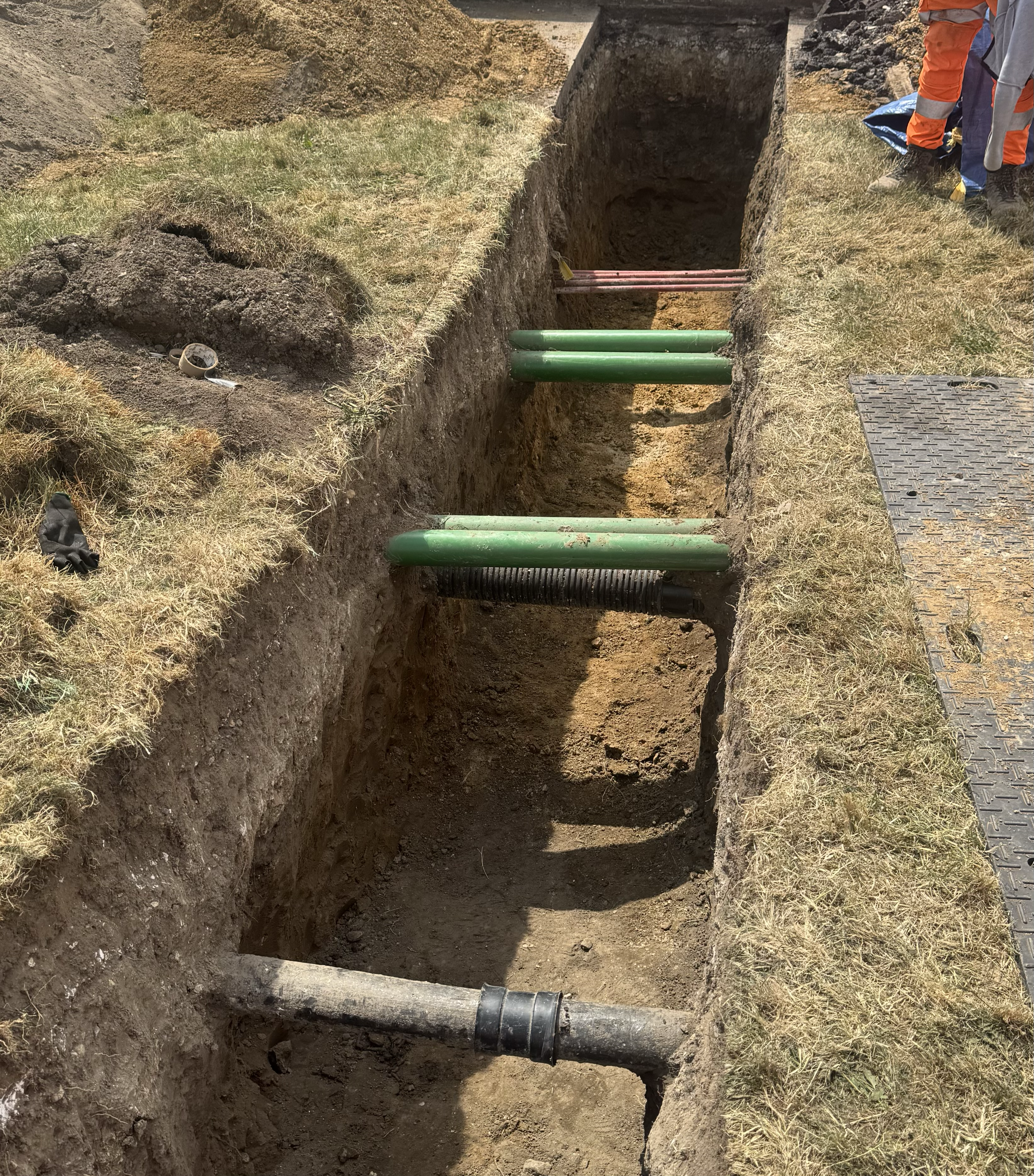
What Is Trial Pitting?
Trial pitting is a fundamental on-site investigation technique used to examine and record the ground conditions beneath the surface. It involves excavating small, controlled pits—usually by hand or mechanical excavator—to visually inspect the soil profile, identify soil types, and locate any shallow structures or services.
This method provides direct access to the ground, offering invaluable information for geotechnical and construction design.
How We Carry Out Our Investigation?
At TS Site Investigation, every project begins with a site-specific Risk
Assessment and Method Statement (RAMS).
We plan all works in accordance with CDM 2015 regulations and BS 5930 to
ensure that safety, quality, and accuracy are maintained at all times.
Before excavation, our team conducts:
Utility searches and CAT & Genny scans to locate underground services.
Risk assessments to determine access, plant use, and safe working zones.
Method statements outlining excavation techniques, sampling procedures, and reinstatement steps.
During excavation, pits are carefully benched or shored where necessary, and all soil horizons are logged by qualified technicians. Representative samples are taken for laboratory testing, with photographs and detailed field notes recorded throughout.
Upon completion, the area is backfilled and reinstated safely and neatly to client standards.
Typical Applications
Trial pits are widely used across construction, infrastructure, and environmental projects, including:
Determining soil bearing capacity for foundation design.
Exposing existing foundations or utilities before redevelopment.
Checking for shallow obstructions or made ground.
Collecting samples for chemical or geotechnical testing.
Performing infiltration (BRE 365) or CBR tests within the pit.
Who Needs Trial Pitting and Why?
Trial pitting provides vital ground information for developers, engineers, and architects who need reliable data before construction.
It also supports local authorities, contractors, and environmental consultants investigating ground stability or contamination.
By giving direct visual access to subsurface conditions, trial pits help reduce design uncertainty, prevent unexpected costs, and ensure safe, efficient construction.
Why Choose TS Site Investigation?
Fully compliant RAMS and CDM procedures on every project.
Experienced, qualified technicians with a focus on safety and accuracy.
Detailed reporting with photographic logs and stratigraphic descriptions to BS 5930 standards.
Rapid mobilisation and flexible equipment suited to both open and confined sites.
We combine practical field experience with a strong safety culture — ensuring that every investigation is carried out responsibly, efficiently, and to the highest professional standard.
FAQs
-
The cost of a trial pit can vary depending on several factors, including access restrictions, pit depth, the need for shoring, required reinstatement, site safety requirements, and whether mechanical excavation or hand-digging is necessary. Additional elements such as utility scanning, laboratory testing, or traffic management may also influence pricing. Every project is assessed individually so that the quotation reflects the site conditions, risks, and scope of work.
-
Yes. Our team works in restricted spaces such as narrow passages, internal areas, basements, and limited-access sites. Where mini excavators cannot be used, we perform hand-digging, or we can deploy vacuum excavation (Vac-Ex) if required for sensitive utility areas. We tailor the method to the constraints of each site.
-
Yes, trial pits are often required even when drawings exist, because older plans can be inaccurate or outdated. Structures may have been modified, utilities rerouted, or ground conditions changed over time. Trial pits give engineers current, visual confirmation of what is actually below ground. This prevents design errors, unexpected costs, and on-site delays.